
Digesting reading lists with Claude
I try to keep up with the latest and greatest happenings across web development, AI and technology generally. But I'm only one man and there seems to be an endless number of things I need to keep up with. I just don't have the time.
Since Twitter went south, my main source of this information has been through email newsletters. There's something reassuring and familiar about using 30-year-old technology to keep up with the latest trends. I'm a big fan of the likes of Bytes for JS things, build mode for product engineering and Pointer for engineering leadership.
(I also enjoy the design delights of Piccalilli's The Index - but I don't think they'll be thanking me for what's coming up.)
Each edition is great. Every time one makes it into my inbox I try not to open it until I've got a nice chunk of time to sit down and properly digest its contents.
Unfortunately though, it means my inbox ends up like this:
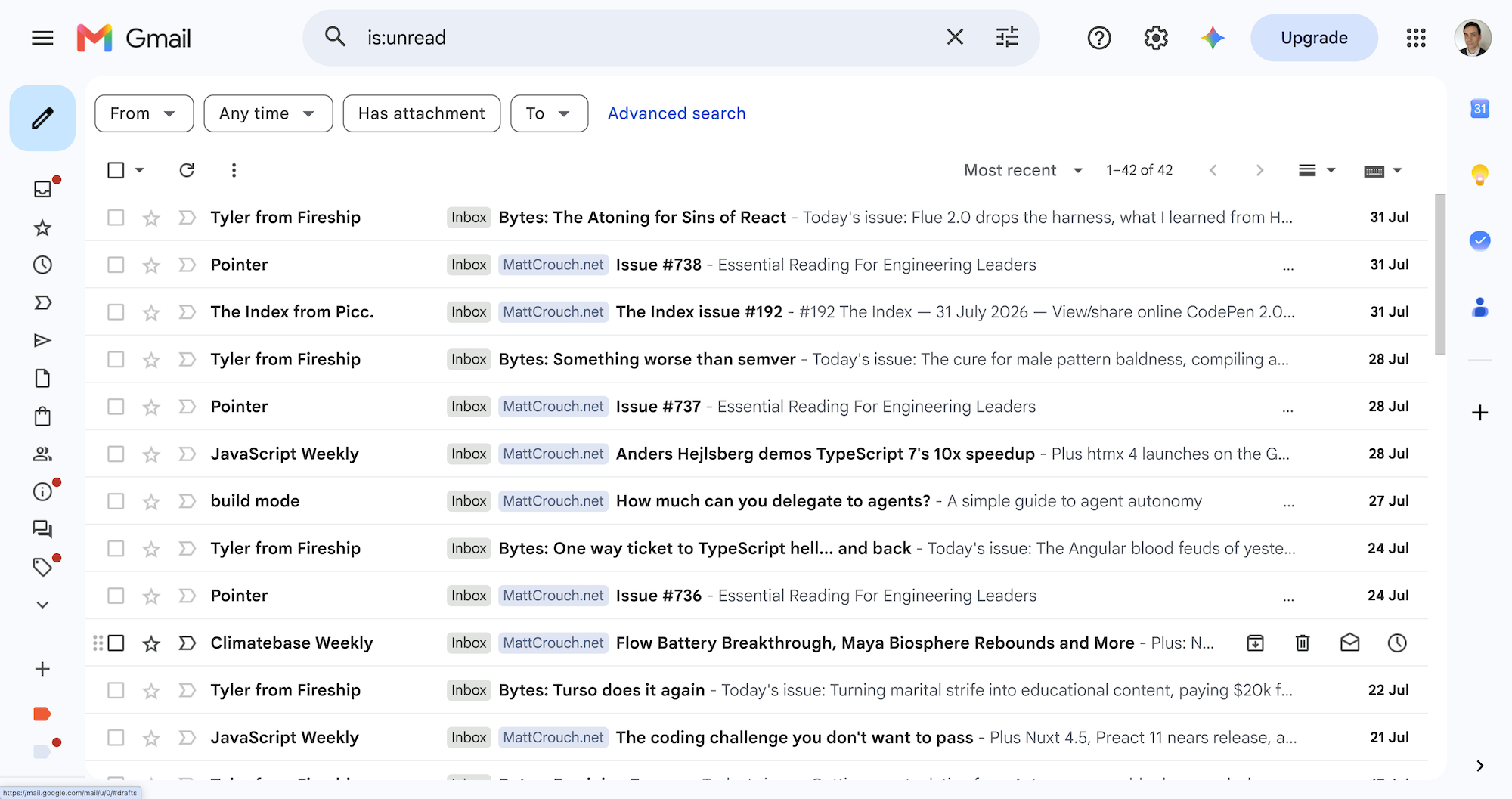
The right time never comes.
This isn't a new problem for me, either. Previously, I would have used Pocket to capture all of those lovely nuggets to consume later. More recently I swapped over to Matter and went through the effort of porting all of my old Pocket links over. But still they wait. Who knows, maybe this Astro thing might take off...
AI-powered learning
School taught me how I can best learn and retain information. At the time, I was that kid with the hand-made flashcards. It was something about transforming the information into my own form that really made things stick. Nowadays I realise that's just active learning but with more Sharpies.
Now it's 2026. AI is rampant - for better or worse. It's now so easy to sit passive and outsource your learning to Claude or ChatGPT. It's doing the thinking. But surely there's a way to encourage active learning as well?
The best results come from an AI agent when it's a conversation. I wanted to explore how that running context could be used to build up knowledge on both my side and the agent.
Setting up a discussion
A lot of these newsletters are lists of links to other articles. When I got the time, I would skim through the list, pick out the ones I'd want to read more into and then just... sit and read through them. Like a caveman.
Once I moved on to the next one, the memories were already fading. The reading was passive. While what I was learning was interesting, I wasn't applying it there and then. I wasn't committing it to memory.
I set out to build a prompt that not only gave me a digest, but nudged me to give my own interpretation.
I am sharing a link. Read it through carefully and provide a concise summary of its contents and a few short takeaway points.
I will likely share a follow-up digest with you to check my understanding. Tell me if I'm in the right direction, but let me know where I've missed the mark. Some of this might come as opinions where I don't agree with the article but worth flagging that conflict.
Immediately, this gave me two things. First, it gave me a concise summary of the article to save me some time. But it also gave me a nudge to digest it.
Crucially though, it would then check my working. I don't always get the right read first time. I apply my own judgement on the work, disagree with its findings and provide counter-points. It pushes back where it disagrees. It's all part of that active learning cycle - applying what I've learned and rephrasing it to commit it to memory.
Bringing in a feedback loop
When revising I was a big fan of spaced repetition and the variability effect. The moment I found the same problem expressed in a different way, it cemented it further. If I could digest and reframe one concept in the form of another - even better.
There's one part of the prompt that really helped with this.
If there's any common ground with another article I may have shared in the past, make sure to call it out.
Claude is great at reaching into your past conversations and working out links between them. It's kind of its thing.
What I had done is set up a project within Claude to contain all of these chats, with the prompt as the instructions. I could then pass it a link and it would read the post, give me a summary, pull out any relevant connections to previous articles and then challenge me for my thoughts.
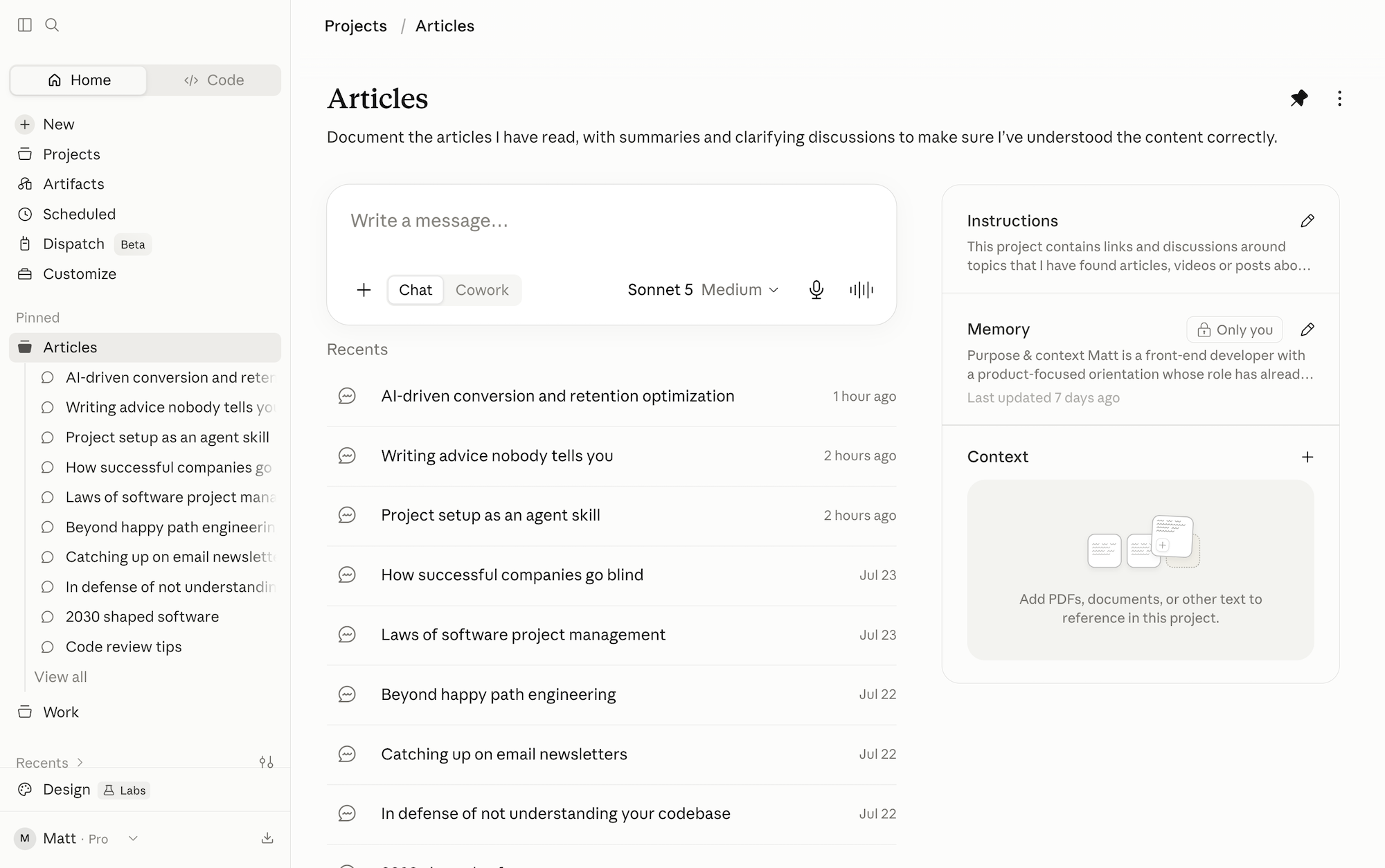
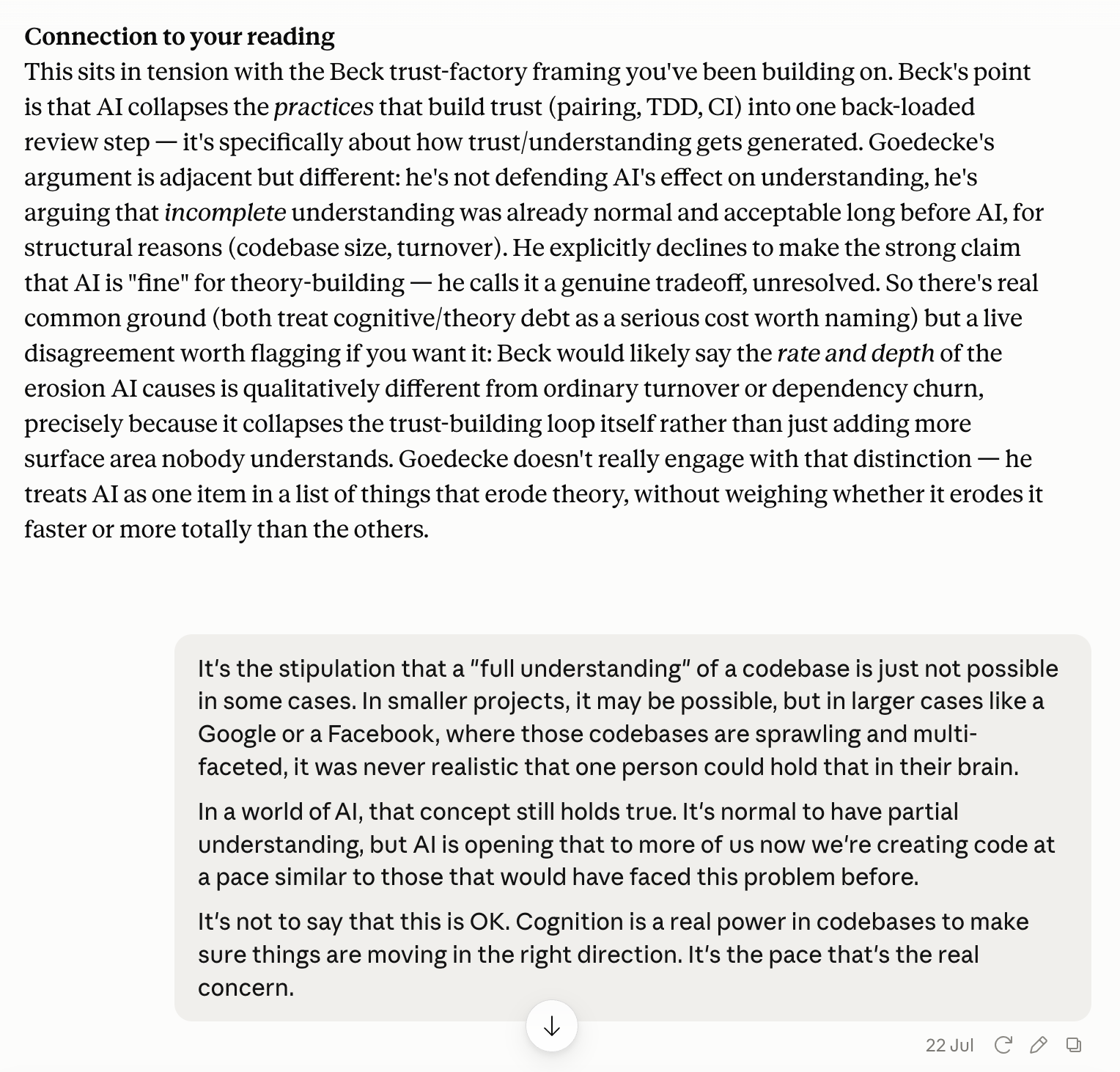
What transpires is a back-and-forth with Claude about my framing of the topic at hand. It calls out inconsistencies and where I've taken liberties with the core message of the piece, but it all ultimately adds to the framing. If it finds something in an article I shared on a previous one it calls it out. It's all world-building.
Where it doesn't work
The obvious next thought is that AI already has knowledge of everything, so why not just feed it your emails directly and cut out the middle man? And you're right, it can.
I gave it access to my emails by way of an experiment. I asked it to pull out some recent newsletters I'd missed, surface some articles it thought I would be interested in, and give me the summaries of those. It absolutely did that.
The problem was that it wasn't me doing that initial sorting. It wasn't me looking through the list and seeing what itched my brain. All I could think about was the articles it didn't choose to highlight - what could I be missing there?
The second problem was the quantity. There's only so much you can optimise the learning process. Anyone who's pulled an all-nighter before the big exam can attest to that. Only so much is going in at one time, and it's hard to build those connections en masse.
In short, you can't shortcut the process. It is the process.
A skill you can use
Having said that, I've extracted this prompt and made it a skill I can share with all of you. It's a bit more generic, but applies to more agents and is more open to customisation. PostHog's piece on writing agent skills made the case for that - describe the process rather than define it, and leave enough open for the AI to do its own thing.
You can find it in my new skills repo in GitHub. You can hook it up into your own Claude instance. But failing that, it's generic enough to share the skill with your AI of choice. I hope to be sharing more of those skills soon, so keep an eye out for updates.
For now, my Claude project just has one instruction pointing to that skill. It seems to be working great. I look forward to tinkering with it and learning more about the world in the future.
I don't think it's a learning approach for everyone, but for me it's a step in the right direction. Now I've just got to tackle those 42 unread emails...