
Finding My Voice
One of the things I am quite proud of is sticking at this blogging lark. What started as a university side project back in 2009 has stayed, in one form or another, right here. Every single post, through every single technological niche I fell the wrong side of, has stayed right here. All written in my self-deprecating, Brit-leaning and comma-heavy house style. Everything written by hand. It's all me.
I think there's real power in the act of writing. For you, you know I've considered every word and how it all flows together to get the right message across. For me, it's a chance to reconcile all my incoherent thoughts and opinions into one place and force myself to really understand a problem before I share it.
The flip-side to all of this is - as it always is - AI. I spend a lot of my day skimming through paragraphs from my colleagues knowing that I'm the first human to have read them. Every flat sentence, em dash, and "It's important to note that…" sounds nothing like you.
So how can you make AI output sound more human? It's not merely text — it's nuance. Let's dive into that.
Getting profiled
Getting AI to do anything is always best when it's got a reference to go on. It's a good thing I have 163 blog posts to rifle through.
I've been on a bit of a skill-writing bender recently, so I just asked Claude to check out my blog and create a my-voice skill. I gave it access to my Markdown files and let it go to town.
Look at my blog posts and determine my writing style. Use it to create a skill called
my-voicewhich allows you to write like I do.
I then got it to check the last 3 years of blog posts against it to check it all fits. What it came back with is part writing style part character assassination.
Here are just some of the points it noted from the skill:
Dry, understated humour. Undercut a serious point with a throwaway aside rather than an explicit joke. Irony markers used sparingly: ✨ around fake-grandiose phrases, a dismissive "right?" after saying something has to be a good idea.
A small recurring vocabulary of warmth: "lovely", "ace", "fantastic", "cracking", "great" show up often as plain, unironic praise. On the flipside, "nightmare" and "big yikes" cover mild frustration - nothing stronger unless a swear is clearly earned.
British. British spelling (colour, centre, organised, favourite). British cultural references (Ceefax, Deal or No Deal, Peep Show, Parkrun). Mild swearing is fine when it fits ("arse", "tosh", "bollocks").
I've never felt so seen. Big yikes.
It's incredibly humbling to see all my years of personal growth boiled down into nine bullet points. But none of it was wrong. It's captured me perfectly.
Training my voice
The first thing I did was try it out in conversation.
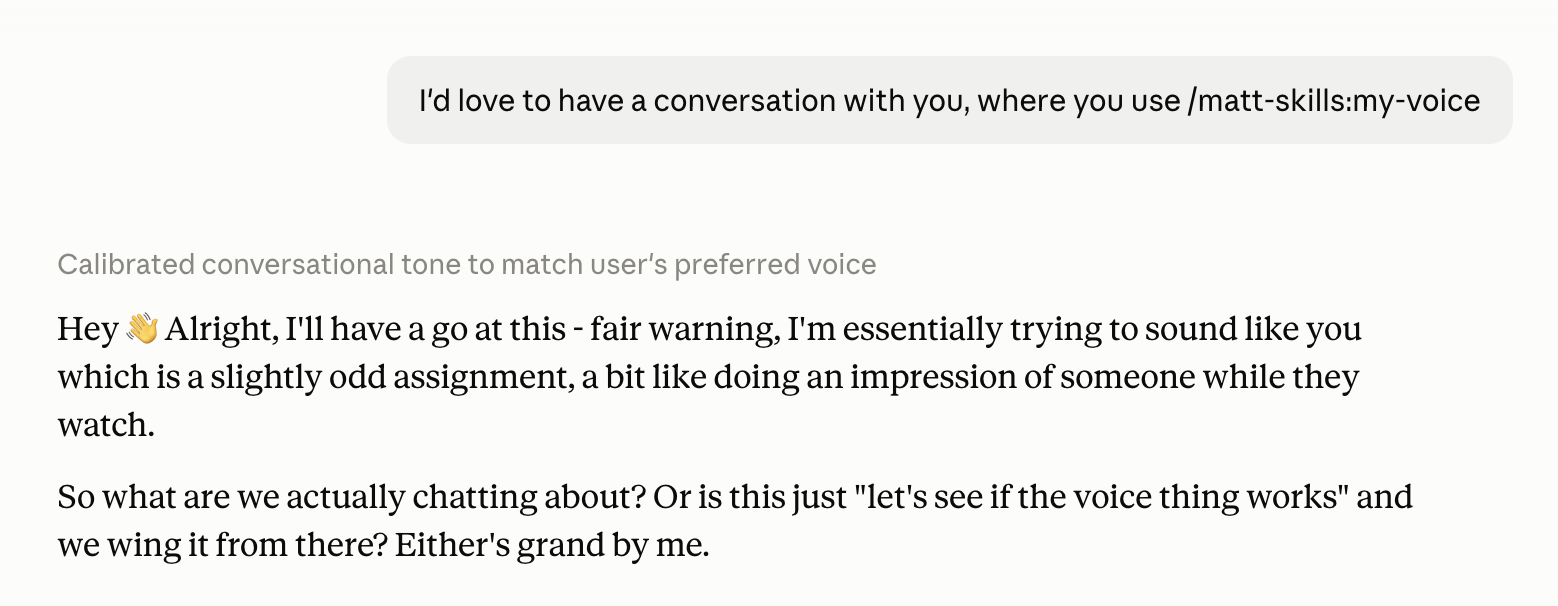
Oh god. I'm so annoying.
I asked it to explain React context and it described it as the "'sod this' solution". Unhelpful, but at least accurate.
After a bit of a back and forth, it felt a bit uncanny valley. It sounded like someone was trying to do an impression of me. It needed a bit of training. Thankfully people cleverer than me have had this idea before.
Claude Blattman suggests adding annotated examples to the skill. Instead of just relying on something like "British", give an example of how that comes across in a sentence.
Jess Allison keeps a list of banned words too, to make sure that the things you wouldn't say end up out of the finished product.
Derek Featherstone also sees value in what you don't say. You can calibrate a skill going forward by giving it access to the edits. Git diffs with appropriate messages tell it what you deleted as well as the why.
A key part of the process is getting the AI to describe who it thinks you are based on skill alone. It's going to do its best to infer who you are given all the information you've provided it. Where you disagree is an assumption it's made, and a gap in the skill that needs patching. Simple.
I gave it a try.
This is someone who doesn't take themselves too seriously and would rather undercut a success than oversell it.
They're warmer about other people than about themselves
At work their personality mostly disappears — they become someone who asks rather than tells
I wasn't expecting a therapy session but it's there in cold black and white.
From there it identified the places where it was stretching, which I fed back to it. At one point I had to describe what a sentence needs for it to earn a "bollocks". Does this still count as engineering?
One process that kept coming up in my research was a test-and-review cycle. Get AI to write something, read it and point out where you think it got it wrong. Feed that response into updating the skill. Repeat until happy.
What I needed was an outlet for some AI-generated thought pieces of questionable quality. Where could I post something where the bar was so low it didn't really matter what I said as long as it was written in the right way?
Sharing on LinkedIn
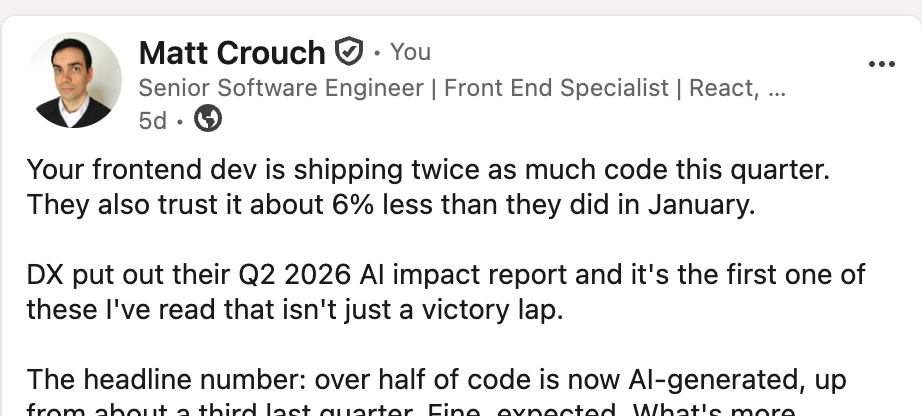
Last week I wrote Digesting reading lists with Claude with my actual human hands. In that, I spoke about how I've got an abundance of newsletters sitting in my inbox waiting to be read. A lot of them involve hot takes about AI. It seemed like LinkedIn was the perfect testing ground for this kind of content.
I got Claude to rifle through my inbox, pull out an article it thought I would be interested in, and then write about it.
Check my emails for a semi-recent newsletter containing an article you think I'd have an interest in.
Read it and rework it in
/my-voicefor a post I can share on LinkedIn. Keep it relatively short.
I briefed it after each generation. "This sounds like something I'd say, but that doesn't". "Great insight, but the bullet point runs on for too long". "I'd probably say this was 'bollocks', but not on LinkedIn." Y'know, that kind of thing.
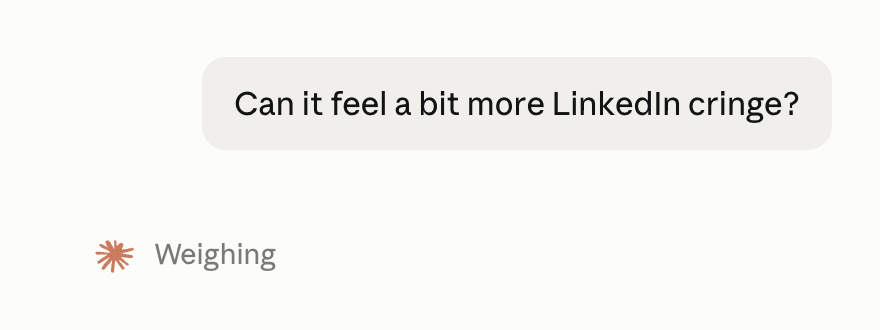
Each step in that iteration got shared on LinkedIn to see if anyone twigged it wasn't really me. Nobody did. Although I can't be sure anyone actually read it, either.
I did that for a week. As an aside, I ended up learning more about how to boost your LinkedIn reach than I have ever cared to before. It seemingly involves "warming up the algorithm" a lot. Who would have guessed the best way to get people to see your LinkedIn posts was to write more on LinkedIn.
But the process taught me the importance of splitting registers. I have vastly different tones here, in the work Slack, during code reviews and also on LinkedIn now apparently. It's important to build the skill with a set of core voice characteristics, but also branch off into separate Markdown files for those different niches. Some need to be more professional than others.
Where's the skill?
It's at this point I'd love to say "You can find it in my skills repo. Give it a try and let me know what you think".
But to be honest, this whole process kind of gave me the creeps. It feels surprisingly accurate now. It was a bit too easy for someone to pretend to be me in a bunch of situations.
It's still a skill but it sits separate from the others for now. I can invoke it when I want to, but I hope I never want to. Getting AI to do the writing robs it of value for both of us.
All I've done now is sow that seed. You'll never quite know if it's me you're talking to. I hope that makes you as uncomfortable as it has done me.